The Complete Guide to Reading Bread Labels at Nigerian Supermarkets
Stop Guessing. Here Is What That Bread Label Is Actually Telling You.
You pick up a loaf of bread at Shoprite or Justrite, flip it over, and stare at a wall of numbers, percentages, and ingredient names that sound like they belong in a chemistry lab. You put it back. You grab the one with the nicest packaging. Sound familiar?
You are not alone. Most Nigerians buy bread based on price, size, or the brand jingle they grew up hearing. The label? That small print on the back? Ignored. But that label is where all the important information lives: what you are putting in your body, whether the health claims on the front are real, and whether that loaf of “whole wheat” bread is truly whole wheat or just wearing a costume.
This guide will change the way you shop for bread forever. By the time you finish reading, you will be able to walk into any Nigerian supermarket and decode any bread label in under two minutes. You will know what to look for, what to avoid, and exactly which claims to trust and which ones to side-eye.
No chemistry degree required.
Why Reading Bread Labels at Nigerian Supermarkets Matters More Than Ever
Nigeria’s bread market has exploded. Walk into any major supermarket in Lagos, Abuja, Port Harcourt, or Ibadan, and you will find an entire aisle dedicated to bread alone. Artisan loaves. Sliced sandwich bread. Whole grain options. Low-sugar varieties. Gluten-free alternatives. There is more choice today than at any point in Nigerian food history.
But more choice also means more confusion. And more confusion means more misleading marketing.
Food producers know that Nigerian consumers are increasingly health-conscious. Terms like “whole wheat,” “high fibre,” “no added sugar,” “fortified,” and “multigrain” are appearing on more and more bread packages. The problem is that some of these claims are regulated, many are not, and some are outright misleading. A loaf labelled “wheat bread” may contain less than 10% actual whole wheat flour. A bread described as “low sugar” may still contain high-fructose corn syrup under a different name.
This is not unique to Nigeria. It happens globally. But in a market where food labeling regulations are still catching up to industry practices, the responsibility falls heavily on the consumer to be informed. And that is what this guide is for.
Understanding the Bread Label Structure at Nigerian Supermarkets
Before you can decode a bread label, you need to know what you are looking at. Nigerian food labels, regulated broadly under the National Agency for Food and Drug Administration and Control (NAFDAC), follow a general structure that applies to packaged bread sold in supermarkets.
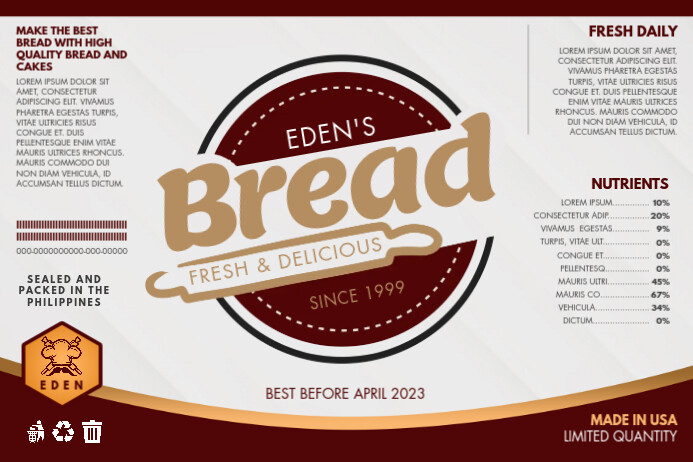
Most bread labels include several distinct sections. These are the product name and brand, the net weight or quantity, a list of ingredients, a nutrition facts panel, manufacturing and expiry dates, the NAFDAC registration number, and the manufacturer’s contact information. Some also include health or marketing claims on the front of the package.
Each section tells you something different. Let’s go through all of them.
How to Read the Ingredients List on Nigerian Bread Labels
The ingredients list is arguably the most important section on any bread label, and it is the one most people skip entirely.
Here is the golden rule: ingredients are listed in descending order by weight. The first ingredient listed is present in the largest quantity. The last ingredient is present in the smallest quantity. This simple rule changes everything.
What the First Ingredient on a Nigerian Bread Label Tells You
If the first ingredient on a Nigerian bread label says “enriched wheat flour,” “refined wheat flour,” or simply “wheat flour,” you are holding a white bread, regardless of what the packaging says. White bread is made from refined flour, which has had most of its fibre and nutrients stripped away during processing.
If the first ingredient says “whole wheat flour” or “whole grain flour,” that is a genuinely different product. Whole grain flour retains the bran and germ layers of the wheat kernel, which means it delivers more fibre, more vitamins, and a slower release of energy into the bloodstream.
The trick some manufacturers use is listing “wheat flour” and then adding a small amount of whole wheat flour further down the list, then labeling the product “wheat bread.” Technically accurate. Practically misleading. Always check what comes first.
Common Ingredients in Nigerian Bread Labels and What They Mean
Here is a breakdown of the ingredients you will encounter most often on Nigerian supermarket bread labels:
- Wheat flour / Enriched wheat flour: Refined white flour. The “enriched” part means some synthetic vitamins were added back after processing. Common in most standard loaves.
- Whole wheat flour: The full grain, including bran and germ. Genuinely nutritious. Should appear first for a truly whole wheat bread.
- Cassava flour / Composite flour: Many Nigerian breads now include a percentage of cassava flour as part of the federal government’s flour substitution policy. This affects texture and shelf life.
- Sugar / Glucose / Fructose / High-fructose corn syrup: All forms of added sugar. Look for how many appear in the list and where they are positioned.
- Vegetable oil / Palm oil: Used for texture and moisture. Palm oil is common in Nigerian bakeries. Neither is inherently harmful in moderate amounts.
- Yeast: Natural leavening agent. Fine.
- Salt: Present in virtually every commercial bread. The quantity matters for people watching sodium intake.
- Preservatives (e.g., Calcium Propionate, Potassium Sorbate): Extend shelf life. Approved for use and generally safe at the levels used in bread. Common in supermarket loaves.
- Emulsifiers (e.g., DATEM, Lecithin, Mono- and Diglycerides): Improve texture and shelf life. Lecithin, often derived from soy, is among the most common.
- Improvers / Dough conditioners (e.g., Ascorbic Acid, Azodicarbonamide): Speed up industrial bread production. Azodicarbonamide is controversial in some markets but is still used in several countries.
- Fortification additions (e.g., Iron, Folic Acid, Vitamins B1, B2, B3, B9): Nigeria has a mandatory wheat flour fortification program. You will see these on many labels. This is generally a positive thing, especially for folic acid intake in women of reproductive age.
The shorter the ingredients list, the closer the bread is to a traditional, minimally processed product. A good artisan-style bread might only have five to seven ingredients. An ultra-processed supermarket loaf can have fifteen or more.
Decoding the Nutrition Facts Panel on Nigerian Bread Labels
The nutrition facts panel is the grid of numbers usually found on the back or side of a bread package. It looks intimidating, but once you understand its structure, it becomes your most reliable decision-making tool.
Serving Size: The First Number That Can Trick You
Every value on the nutrition facts panel is calculated per serving, not per loaf. The manufacturer defines what a serving size is. On Nigerian bread labels, a serving is almost always defined as one slice, and one slice typically weighs between 25 grams and 35 grams.
Why does this matter? Because if you routinely eat two or three slices at a time, which most people do for a sandwich or toast, you need to multiply all the numbers by two or three. A bread that looks modest at 80 calories per serving suddenly becomes 240 calories for a three-slice meal.
Always check the serving size before evaluating any other number on the panel.
Calories: How Much Energy Is in Your Nigerian Bread?
Most white bread slices sold in Nigerian supermarkets contain between 70 and 100 calories per slice. Whole grain breads tend to be in the same range, but they are nutritionally superior because the calories come packaged with more fibre, vitamins, and minerals.
Calories are not inherently bad. They are simply energy. The question is whether the calories you are consuming are coming with nutritional passengers, or whether they are empty calories that do little beyond providing energy and potentially spiking blood sugar.
For context, a standard Nigerian adult consuming about 2,000 calories daily might reasonably spend 200 to 300 of those calories on two to three slices of bread at breakfast. The quality of those calories determines how satisfied, energized, and well-nourished they feel for the rest of the morning.
Total Fat, Saturated Fat, and Trans Fat on Nigerian Bread Labels
Most plain bread is relatively low in fat. However, enriched or specialty breads, think milk bread, coconut bread, butter bread, and similar varieties sold at Nigerian supermarkets, can contain significantly more fat.
Saturated fat is the one to watch. Diets high in saturated fat are associated with increased LDL cholesterol and cardiovascular risk. For bread, a reasonable benchmark is keeping saturated fat below 1 gram per serving.
Trans fat is the one to avoid entirely. Partially hydrogenated vegetable oils are the primary source of artificial trans fats, and while many manufacturers have reformulated, some older or smaller-brand products in Nigerian supermarkets may still contain them. The label should list trans fat as 0 grams. If it does not show 0, put the bread back.
Sodium: The Silent Numbers on Nigerian Bread Labels
This is one of the most overlooked numbers on Nigerian bread labels, and one of the most important for long-term health.
A single slice of commercially produced bread typically contains between 100 and 200 milligrams of sodium. That sounds reasonable until you consider that most health guidelines recommend consuming no more than 2,300 milligrams of sodium per day, with an ideal of closer to 1,500 milligrams for people with hypertension.
If you eat three slices of bread at 150 milligrams each, that is 450 milligrams just from the bread, before you add the butter, the processed meat, the margarine, or anything else going on that sandwich. For Nigerians who are also consuming soups, stews, seasoning cubes, and other sodium-dense foods throughout the day, this adds up faster than most people realize.
Hypertension, which Nigerians informally call “high blood,” is extremely prevalent across the country. Paying attention to sodium on bread labels is a genuinely meaningful health act, not just a label-reading exercise.
Carbohydrates, Fibre, and Sugar: Reading Bread Labels the Right Way
The carbohydrate section of a Nigerian bread label contains three critical numbers: total carbohydrates, dietary fibre, and total sugars (which may also be broken down into added sugars on more detailed labels).
Total Carbohydrates: This is the sum of starches, fibre, and sugars. For bread, this number will always be relatively high because bread is, at its core, a carbohydrate food. This is not a problem. Context is everything.
Dietary Fibre: This is where you want to see a higher number. Fibre slows digestion, supports gut health, helps regulate blood sugar, and keeps you feeling full longer. A bread with 3 grams or more of fibre per serving is considered a good source of fibre. A bread with 5 grams or more is considered an excellent source. Most white breads in Nigerian supermarkets deliver only 0.5 to 1 gram of fibre per slice. Whole grain varieties should offer 2 to 4 grams.
Total Sugars / Added Sugars: Commercial bread often contains added sugar to improve taste, aid fermentation, and extend browning during baking. A modest amount (1 to 3 grams per slice) is common and not alarming. However, some Nigerian supermarket breads, particularly milk breads, sweet loaves, and tea breads, can contain 5 to 8 grams of sugar per slice. For a person managing diabetes or pre-diabetes, this is critical information.
Protein in Nigerian Bread: What the Label Tells You
Bread is not a primary protein source, but it contributes to your daily protein intake. Most standard Nigerian bread slices provide 2 to 4 grams of protein per serving. Whole wheat breads tend to offer slightly more because whole grain flour retains more protein than refined flour.
This number matters particularly for Nigerians who rely heavily on bread as a breakfast staple, especially those who may not be combining it with eggs, beans, or other protein-rich foods. A bread with 4 grams of protein per slice versus one with 2 grams per slice makes a meaningful cumulative difference over time.
Unpacking Health Claims on Nigerian Bread Packaging
This is where the real detective work begins. The front of a bread package is essentially a marketing canvas. The back, particularly the ingredients list and nutrition facts panel, is where the truth lives. Here is how to cross-reference the two.
“Whole Wheat” vs. “Wheat Bread” in Nigerian Supermarkets
These two phrases sound almost identical. They mean very different things.
“Whole wheat bread” should contain whole wheat flour as its primary ingredient. Genuine whole wheat bread is brown, denser than white bread, has a heartier texture, and offers significantly more fibre, minerals, and vitamins.
“Wheat bread” simply means the bread contains wheat. All standard white bread contains wheat. The label “wheat bread” on a Nigerian supermarket product tells you almost nothing about its nutritional quality. It is often applied to loaves that are mostly or entirely white flour with added caramel color or molasses to achieve a brownish appearance.
The test: flip the package and check ingredient number one. If it says “whole wheat flour,” you have the real thing. If it says “wheat flour” or “enriched wheat flour,” you are looking at a white bread in a whole wheat outfit.
“Multigrain” Bread Labels at Nigerian Supermarkets
Multigrain means the bread contains multiple types of grains. It does not mean those grains are whole grains. A multigrain bread could contain refined wheat flour, refined corn flour, and refined oat flour. Multiple grains, yes. Whole grains, no.
To find out if a multigrain bread is genuinely nutritious, look for the word “whole” before each grain in the ingredients list. “Whole wheat,” “whole oats,” “whole rye,” and similar terms tell you you are getting the complete grain. Grains listed without “whole” in front of them have been refined.
“High Fibre” Bread Claims on Nigerian Labels
A bread labeled “high fibre” in Nigeria should contain at least 6 grams of fibre per 100 grams of product, in line with general food labeling conventions. Verify this by checking the fibre number in the nutrition facts panel and calculating per 100 grams if the label presents data per slice.
Some products use the term loosely. If a bread calls itself “high fibre” but the nutrition panel shows only 1 or 1.5 grams of fibre per slice and the slice weighs 30 grams, the math does not support the claim. You can call it out.
“No Added Sugar” Bread Labels in Nigerian Supermarkets
This claim means no sugar was intentionally added during manufacturing. However, bread naturally contains small amounts of sugar from starch breakdown during fermentation. “No added sugar” does not mean “zero sugar.” Check the total sugars line in the nutrition facts panel.
Also be alert to ingredient substitutes. A manufacturer can remove table sugar from a recipe but add honey, malt syrup, date syrup, or fruit juice concentrate, which all function as sugars in the body. These may still allow a “no added sugar” claim depending on interpretation.
“Fortified” Bread in Nigerian Supermarkets
Fortification means that vitamins or minerals have been added to the bread, often to compensate for nutrients lost during flour refining, or to address public health deficiencies. In Nigeria, wheat flour fortification with iron, zinc, vitamin A, and folic acid is mandated under federal policy.
This is genuinely good news, especially for populations at risk of micronutrient deficiency. Fortified bread sold in Nigerian supermarkets can meaningfully contribute to daily iron and folate intake. When you see fortification listed on a label, this is not a marketing trick. It is a public health measure.
Comparing Nigerian Supermarket Bread Options: A Label Reading Table
The table below compares typical nutritional profiles of different bread categories commonly found in Nigerian supermarkets. Values are approximate per slice (approximately 30 grams) and represent averages across major brands.
| Bread Type | Calories | Fibre (g) | Sugar (g) | Sodium (mg) | Protein (g) | Recommended For |
|---|---|---|---|---|---|---|
| Standard White Bread | 80 | 0.5 | 2 | 150 | 2.5 | General use; lower cost |
| “Wheat” / Brown Bread | 78 | 1.0 | 2.5 | 155 | 2.5 | Not significantly different from white |
| Genuine Whole Wheat Bread | 82 | 3.5 | 1.5 | 135 | 3.5 | Best everyday choice |
| Multigrain (Whole Grain) | 85 | 4.0 | 1.5 | 140 | 4.0 | Excellent; check “whole” prefix |
| Milk / Sweet Bread | 105 | 0.5 | 6 | 130 | 3.0 | Occasional treat; high sugar |
| Fortified White Bread | 80 | 0.5 | 2 | 150 | 2.5 | Better micronutrient delivery |
| Low-Sugar / Diabetic Bread | 75 | 3.0 | 0.5 | 145 | 3.5 | Diabetes management; check label |
| Cassava-Composite Bread | 82 | 1.5 | 2 | 145 | 2.0 | Local grain diversity; lower gluten |
| Sourdough (if available) | 80 | 1.0 | 0.5 | 165 | 3.0 | Better gut health; lower glycemic |
| Gluten-Free Bread | 90 | 1.5 | 3.0 | 175 | 1.5 | Celiac/gluten sensitivity only |
This table makes one thing very clear: the difference between standard white bread and genuine whole wheat or whole grain bread is significant, particularly in fibre and protein, the two nutrients that most influence how satisfied and energized you feel after eating bread.
The NAFDAC Number: What It Means on Nigerian Bread Labels
Every packaged food product legally sold in Nigeria must carry a NAFDAC registration number. This is a government-issued identifier that confirms the product has been evaluated and approved for sale by the National Agency for Food and Drug Administration and Control.
The format is typically a series of letters and numbers, and it should be clearly printed on the label. A legitimate NAFDAC number provides some assurance that the product met safety requirements at the time of registration. It is not a guarantee that the product is nutritionally optimal, but it is a baseline safety check.
If you pick up a bread at a Nigerian supermarket and there is no NAFDAC number on the label, that is a significant red flag. Do not buy it. This applies especially to artisan or boutique breads that may be produced in smaller facilities and may not have completed the registration process.
You can verify a NAFDAC registration number through the agency’s official portal, though in practice most Nigerian shoppers rely on the presence of the number as a reasonable trust signal rather than verifying each one individually.
Expiry Dates and Manufacturing Dates on Nigerian Bread Labels
Nigerian bread labels must display both the manufacturing date (MFD or MFG) and the expiry date (EXP or Best Before). For commercially produced bread, shelf life typically ranges from five to fourteen days at room temperature, depending on preservative content.
Bread with no preservatives, often marketed as “natural” or “clean label” products, may have a shelf life as short as two to three days. Bread with calcium propionate and other antimicrobials can last ten to fourteen days without visible mold.
A few practical rules:
- Always check the expiry date before purchasing, particularly for bread near the back of the shelf. Retailers sometimes arrange products with older stock at the front.
- The freshness date is a guide to quality and safety. Bread that has passed its best-before date may not be dangerous immediately, but its texture, flavor, and nutritional quality will have declined.
- Store opened bread in a cool, dry place or in the refrigerator during hot and humid Nigerian weather. The fridge slows mold growth significantly, though it can slightly accelerate staling.
Reading Bread Labels for Specific Health Conditions Common in Nigeria
Nigeria has among the highest rates of type 2 diabetes and hypertension in sub-Saharan Africa. These two conditions have a direct relationship with bread consumption, specifically the type of bread you choose and how much you eat. According to research published by global nutrition organizations, dietary fibre intake is directly associated with reduced risk of type 2 diabetes and cardiovascular disease, and whole grain bread is one of the most accessible sources of dietary fibre in urban Nigerian diets.
For Nigerians Managing Diabetes or Pre-Diabetes
Look for bread with a high fibre content (3 grams or more per slice), low added sugar (ideally 2 grams or less per slice), and whole grain flour as the first ingredient. Fibre slows the conversion of carbohydrates into glucose, which means a lower and more gradual rise in blood sugar after eating.
Avoid sweet breads, milk breads, and any bread where sugar, glucose, or a syrup appears among the first five ingredients. These products cause rapid blood sugar spikes, which is precisely what a diabetic or pre-diabetic diet should avoid.
Sourdough bread, if you can find it in Nigerian supermarkets, is worth seeking out. The fermentation process lowers the glycemic impact of the bread significantly, even when made with white flour.
For Nigerians Managing Hypertension
Sodium is your primary concern. Look for bread with 140 milligrams or less of sodium per slice, which qualifies as low sodium by most international standards. Compare brands. Even within the same category, sodium levels can vary by 50 to 80 milligrams per slice between different brands.
Bread labeled “reduced sodium” should contain at least 25% less sodium than the standard version of the same product. Check whether such a claim is backed up by the nutrition facts panel.
For Children and Growing Adolescents
The priority for children is protein, micronutrients, and fibre. Fortified breads deliver valuable iron and B vitamins that support growth and cognitive development. Whole grain varieties add fibre that supports digestive health.
Avoid feeding children a diet heavy in sweet bread and milk bread. These products are fine as occasional treats, but their high sugar content and low fibre levels make them poor everyday staples for growing bodies.
Bread Packaging Claims That Mean Nothing Nutritionally in Nigeria
Some marketing phrases are so common on Nigerian bread packaging that shoppers have come to treat them as meaningful quality signals. They are not. Here are a few to stop trusting:
“Baked Fresh Daily”: This tells you about the production schedule, not the ingredients. Fresh white bread is still white bread. Freshness is a texture and flavor quality claim, not a nutritional one.
“Family Size” / “Extra Value”: These refer to portion quantity relative to price. They say nothing about nutritional quality.
“Energizing” / “Power Bread” / “Brain Boost”: These are marketing words with no regulated definition in the Nigerian food context. Any bread provides energy, because all bread contains carbohydrates. A brand calling its bread “energizing” is not making a meaningful nutritional claim.
“Natural Ingredients”: This phrase is almost completely unregulated. “Natural” has no fixed legal definition in Nigerian food labeling. Virtually anything can be called natural. Check the ingredients list instead.
“Premium”: Refers to brand positioning and price point. Not a nutritional indicator.
How to Compare Two Bread Brands at a Nigerian Supermarket in Under Two Minutes
Here is a practical, real-world process you can use while standing in the bread aisle at Shoprite, Spar, Justrite, or any other Nigerian supermarket:
Step 1: Check ingredient number one. Whole wheat flour or whole grain flour? Good. Wheat flour or enriched wheat flour? White bread.
Step 2: Count the ingredients. Fewer is generally better. More than 15 ingredients is a sign of heavy industrial processing.
Step 3: Check fibre per slice. Aim for 2 grams minimum. 3 to 4 grams is excellent.
Step 4: Check sugar per slice. Under 2 grams is ideal for everyday bread. Over 4 grams, think carefully.
Step 5: Check sodium per slice. Under 150 milligrams is reasonable. Over 200 milligrams is high.
Step 6: Look for the NAFDAC number. No number, no purchase.
Step 7: Check the expiry date. Always.
That is it. Seven steps, two minutes, better bread.
The Best Bread Choices You Can Make at Nigerian Supermarkets Right Now
Based on everything covered in this guide, here is a practical ranking of bread choices you can make at Nigerian supermarkets, from best to good to acceptable:
Best choice: Genuine whole wheat or whole grain bread where the first ingredient is explicitly labeled “whole wheat flour” or “whole grain flour,” with 3 or more grams of fibre per slice, less than 2 grams of added sugar, and under 150 milligrams of sodium.
Good choice: A fortified white bread with low sodium (under 140 milligrams), minimal added sugar, and a short, recognizable ingredients list. Not as nutritious as whole grain, but better than unfortified alternatives and a reasonable everyday choice.
Acceptable with awareness: Standard white or “wheat” bread that is honestly labeled, not deceptively marketed, and consumed in modest portions alongside nutritious accompaniments like eggs, beans, or avocado.
Occasional treat only: Milk bread, coconut bread, sweet loaves, and similar specialty breads with high sugar content. Delicious. Not for everyday consumption.
Approach with skepticism: Any bread making bold health claims (multigrain, high fibre, superfood, diabetic-friendly) without the nutrition facts panel to back them up. Always verify.
According to data from LinkedIn’s global workforce insights on food industry jobs and health trends, consumer demand for transparent food labeling and nutritionally honest products is growing significantly across emerging markets, including Nigeria. This means the market will likely continue improving, but informed consumers drive that change.
A Word on Nigerian Artisan and Bakery Bread vs. Supermarket Bread
Not all bread sold in Nigerian supermarkets comes in plastic-wrapped, factory-produced loaves. Many supermarkets now carry in-store bakery bread or bread from smaller artisan producers. These products often have less standardized labeling, and in some cases, minimal labeling at all.
For artisan or bakery bread, ask questions directly. What flour is used? Is it fortified? Does it contain preservatives? Good artisan bakers are usually happy to talk about their ingredients. The absence of a nutrition facts panel on fresh bakery bread is understandable and is common worldwide, but you should still be able to ask about the basic ingredients.
The advantage of artisan bread is often a shorter, cleaner ingredient list and a fermentation process (particularly for sourdough-style breads) that improves digestibility and lowers glycemic impact. The disadvantage is less standardization and, in some cases, higher price.
For everyday household consumption, factory-produced bread with clear labeling and a NAFDAC number is often the more practical choice. You know exactly what you are getting. With artisan bread, you rely more on trust and conversation.
Conclusion: The Bread Aisle Will Never Look the Same Again
Reading bread labels is not a chore reserved for nutritionists and health fanatics. It is a basic life skill that anyone buying food for themselves or their family deserves to have.
The Nigerian food market is changing. Consumers are asking better questions. Manufacturers are, slowly but surely, being held to higher standards. And the information you need to make a genuinely good choice is already printed on the back of every packaged loaf in every Nigerian supermarket. It was always there. Now you know how to read it.
Here is the single most important thing to take away from this entire guide: the front of the package sells the bread. The back of the package tells the truth about it. Flip it over.
Your health, your wallet, and honestly your taste buds over the long run will thank you.
Ready to Shop Smarter?
Share this guide with someone who always grabs bread without checking the label. You might genuinely improve their health.
Drop a comment below: What bread brand do you buy most often in Nigeria? Have you ever checked the ingredients list? We want to know what you found.
This article is written for general informational purposes and does not constitute medical or dietary advice. Individuals with specific health conditions such as diabetes, celiac disease, or hypertension should consult a qualified healthcare provider or registered dietitian for personalized guidance.