Secrets of 5 Blue Zone Communities That Live Past 100
Somewhere on a sun-drenched Greek island, a 97-year-old woman is tending her garden, napping after lunch, and meeting friends for herbal tea. She has never tracked a macronutrient in her life.
And she will probably outlive most people half her age.
These pockets of extraordinary human longevity are not accidents, myths, or quirks of genetics. They are patterns. Documented, repeatable, astonishingly consistent patterns that researchers have now studied across five distinct cultures on four different continents, and the findings are as simple as they are profound.
Welcome to the world of the Blue Zones, the five communities on Earth where living past 100 is not a remarkable exception but a quiet, unremarkable norm.
This is not another listicle about eating more salad. This is a deep dive into what these communities actually do, what the science actually says, where the skeptics have legitimate points, and most importantly, exactly how you can transplant these principles into a life that probably looks nothing like a Sardinian shepherd’s.
Medical Disclaimer: This article is written for educational and informational purposes only. It does not constitute medical advice. Individual health needs vary significantly. Before making changes to your diet, exercise routine, or lifestyle, please consult a qualified healthcare professional or registered dietitian who can advise you based on your personal health history.
What Are Blue Zone Communities and Why Do They Matter?
The term “Blue Zone” was not invented by a marketing team, though it has since been adopted by one.
It started with blue ink on a paper map.
In the early 2000s, two researchers, demographer Michel Poulain and physician Gianni Pes, were mapping villages in Sardinia, Italy, that had unusually high concentrations of male centenarians. They marked each qualifying village with a blue circle. The region inside those blue circles became the first “Blue Zone.”
National Geographic explorer and journalist Dan Buettner heard about the work, joined the research effort, and eventually expanded the investigation globally. Working with teams of anthropologists, epidemiologists, and demographers funded in part by the National Institute on Aging, Buettner’s group identified five regions that met the demographic criteria for extraordinary longevity.
Those five regions are Okinawa, Japan; Sardinia, Italy; Ikaria, Greece; the Nicoya Peninsula in Costa Rica; and Loma Linda, California.
What makes these places remarkable is not just that people live long. It is that they live long and well. According to research, Blue Zone residents have among the world’s highest proportions of centenarians. Most residents live seven to ten years longer than the average American and have lower rates of chronic diseases like cancer, cardiovascular disease, diabetes, and dementia.
That last part is worth pausing on. It is one thing to add years to a life. It is another thing entirely to add life to those years
.
The Blue Zone Longevity Research: What the Science Actually Found
Before diving into each community, it is worth being honest about the state of the science, because the Blue Zone concept is not without its critics, and intellectual honesty serves everyone better than cheerleading.
The Danish Twin Study established that only about 20 percent of how long the average person lives is dictated by our genes, whereas the other 80 percent is dictated by our lifestyle. That single finding is the premise on which all Blue Zone research rests: if lifestyle drives 80 percent of longevity outcomes, then identifying the lifestyle patterns of the world’s longest-lived people should give the rest of us a meaningful blueprint.
These areas were dubbed Blue Zones, where people reach age 100 at ten times greater rates than in the United States. Once these areas were established, researchers sent in a team of anthropologists, demographers, epidemiologists, and researchers to identify the lifestyle characteristics that might explain longevity.
The criticism of Blue Zone research is legitimate and worth acknowledging. Some researchers have raised questions about the reliability of birth records in certain regions, particularly older records from rural areas. The Nicoya data, for instance, has been challenged in a 2023 demographic paper suggesting the longevity advantage may not extend to more recent birth cohorts. And the data from Okinawa is complicated by the fact that the island’s extraordinary longevity was largely a pre-World War II phenomenon, with life expectancy declining significantly in subsequent generations as Western diets and transportation infrastructure arrived.
The growth in life expectancy in Okinawa has slowed, particularly in comparison to other prefectures in Japan. The arrival of modern Western diets and transportation infrastructure that does not promote walking has led to reduced activity levels, lower energy expenditure, and increasing rates of obesity in Okinawa prefecture.
That fact is not an argument against the Blue Zone framework. It is the most powerful argument for it. When a community abandons the habits associated with longevity, longevity declines. The lifestyle is not incidental. It is the mechanism.
The dietary patterns observed in Blue Zones provide a compelling model for promoting longevity and reducing the risk of chronic diseases. These predominantly plant-based diets feature whole grains, legumes, vegetables, and fruits, with moderate consumption of animal-derived products. The presence of fermented foods, healthy fats, and a focus on caloric restriction is associated with reduced inflammation, improved cardiovascular health, and slower biological ageing.
With appropriate context and calibrated skepticism in place, the patterns remain genuinely instructive.
Blue Zone Community 1: Okinawa, Japan (Where Women Live Longest)
Okinawa sits in the East China Sea, south of the Japanese mainland, and has long attracted researchers interested in longevity, particularly female longevity. The island has historically produced one of the highest concentrations of women centenarians anywhere on Earth.
The traditional Okinawan diet, meaning the diet observed before the widespread arrival of Western food culture after 1945, was remarkable in its composition. The food intake graph for Okinawa around 1950 shows that 76 percent of the diet was made up of vegetables, around 15 percent was rice and grains, and 6 percent legumes. All other foods including animal products and sweetened or processed foods accounted for just a few percentage points.
The star of the Okinawan table was not seaweed or tofu, though both featured prominently. It was the purple sweet potato, known locally as beni-imo. High in antioxidants, low on the glycemic index (a measure of how quickly a food raises blood sugar), and extraordinarily cheap to grow, it formed the caloric foundation of everyday meals.
But what Okinawans ate may matter less than how they ate it.
Hara hachi bu, the Okinawan 2,500-year-old Confucian mantra said before meals, reminds them to stop eating when their stomachs are 80 percent full. The 20 percent gap between not being hungry and feeling full could be the difference between losing weight or gaining it.
Think of it as a built-in portion control ritual that required no app, no calorie counter, and no willpower, just a phrase repeated before every meal for a lifetime.
Okinawans also created what they called moais, small groups of five close friends who committed to each other for life, meeting regularly for mutual support, conversation, and accountability. Research consistently shows that social isolation is as damaging to health as smoking 15 cigarettes a day. The moai system made social connection structural rather than optional.
Key Okinawan longevity habits to copy:
- Eat until you are 80 percent full, then stop, every single meal
- Build your meals around vegetables and legumes, with small amounts of protein
- Cultivate a small, committed social circle that you see regularly
- Find and articulate your ikigai, your reason for waking up each morning
- Eat earlier in the day; make dinner the lightest meal
Blue Zone Community 2: Sardinia, Italy (Where Men Outlive Everyone)
If Okinawa is where women live longest, Sardinia, specifically its rugged mountain interior, is where men do.
The highest concentration of centenarian men in the world is in Sardinia, where sheep farming is the most common occupation and involves at least five miles of daily walking up and down mountains.
That is not hiking as exercise. That is work. The shepherds of Sardinia’s Nuoro Province were not doing it for their health. They were doing it to tend their flocks. But the cardiovascular and metabolic benefits were identical to a structured exercise program, because the body does not distinguish between deliberate and incidental movement.
The classic Sardinian diet is plant based, consisting of whole-grain bread, beans, garden vegetables, and fruits. Sardinians also drink wine with meals, specifically a local variety called Cannonau, which has the highest concentration of artery-scrubbing flavonoids of any wine in the world.
One practice worth noting is how Sardinians prepare their carbohydrates. Rather than baking soft commercial bread, they traditionally eat carta di musica, a paper-thin flatbread made from durum wheat. Its preparation and density lower its glycemic load significantly compared to the fluffy supermarket loaves most of the world consumes.
The social structure of Sardinian longevity is also distinctive: multigenerational households remain common, meaning that elderly men maintain daily meaningful roles, as grandparents, advisors, and keepers of family memory. They are not retired to the margins of family life. They are central to it.
Key Sardinian longevity habits to copy:
- Walk. A lot. Especially on varied terrain.
- Eat whole-grain and sourdough breads rather than refined white bread
- Include wine with meals in moderation if you drink (and skip it if you do not)
- Maintain deep, intergenerational family connections
- Eat minestrone soup and beans several times a week
Blue Zone Community 3: Ikaria, Greece (The Island Where People Forget to Die)
Ikaria is a small, steep island in the Aegean Sea with a famously relaxed relationship with time. Clocks are optional. Schedules are suggestions. Naps are mandatory.
People on this tiny Aegean island live 8 years longer than Americans do. They experience 20 percent less cancer, half the rate of heart disease, and almost no dementia. Ikarians eat a variation of the Mediterranean diet, with lots of fruits and vegetables, whole grains, beans, potatoes, and olive oil. Ikarians also downshift with a midafternoon break.
The word “almost no dementia” is worth sitting with. In many Western countries, dementia affects roughly one in three people over the age of 85. On Ikaria, researchers found cognitive decline so rare that it was difficult to study statistically. The island’s combination of diet, social connection, stress management, and regular napping appears to protect the aging brain in ways that modern medicine has yet to fully explain.
The Ikarian diet is essentially a textbook Mediterranean diet, heavy on olive oil, legumes, wild greens, and seasonal vegetables, with moderate fish, minimal meat, and herbal teas made from rosemary, sage, and oregano that have demonstrable anti-inflammatory properties.
An interesting fact about some of the Blue Zones is that sourdough bread seems to be a dietary staple, especially in Ikaria, Greece. The process of producing sourdough bread reduces the number of sugars (lowering the glycemic index) and gluten in bread.
The island’s relatively poor soil and geographic isolation meant that Ikarians traditionally ate what was available: local, seasonal, and largely unprocessed. They were not following a nutrition plan. They were just eating food.
Key Ikarian longevity habits to copy:
- Take afternoon naps without guilt, even a 20-minute rest reduces cardiovascular risk
- Cook with olive oil generously and liberally
- Drink herbal teas made from rosemary, sage, or wild oregano instead of processed drinks
- Build your diet around legumes, leafy greens, and potatoes
- Embrace an unhurried relationship with time when possible
Blue Zone Community 4: Nicoya Peninsula, Costa Rica (Purpose as Medicine)
The Nicoya Peninsula sits on Costa Rica’s Pacific coast, and it holds one of the most quietly remarkable longevity records in the Western hemisphere.
Nicoyans spend just 15 percent of what America does on healthcare and are more than twice as likely as Americans to reach a healthy age of 90 years. Faith and family play a strong role in Nicoyan culture. So does plan de vida, or reason to live, which helps Nicoyan elders maintain a positive outlook and active lifestyle.
The Nicoyan diet has one genuinely unusual feature that researchers find fascinating: the mineral content of the local drinking water. Nicoyans eat little to no processed foods but plenty of antioxidant-rich tropical fruit. They also have a unique secret: calcium and magnesium-rich water, which wards off heart disease and promotes strong bones.
The dietary foundation of the Nicoya Peninsula is the traditional Mesoamerican combination of corn tortillas, black beans, and squash. These three foods together form what anthropologists call the “Three Sisters,” a nutritionally complementary trio that collectively provides complete protein, complex carbohydrates, fiber, and essential micronutrients.
But the most compelling finding from Nicoya may be psychological.
The concept of plan de vida, which translates roughly as “life plan” or “reason to live,” functions as the Nicoyan equivalent of the Okinawan ikigai. Elderly Nicoyans who maintain a clear sense of purpose, whether caring for grandchildren, tending a garden, or serving their faith community, show measurably better health outcomes than those without one.
Purpose, it turns out, is not just a philosophical nicety. It is a physiological variable.
Key Nicoyan longevity habits to copy:
- Build meals around beans, corn, and squash as often as possible
- Articulate a clear personal reason to live that extends beyond your own interests
- Stay physically active through light work and walking throughout the day
- Maintain strong family bonds and visit loved ones regularly
- Eat tropical fruits like papaya and mango as daily snacks
Blue Zone Community 5: Loma Linda, California (The American Exception)
Loma Linda is the only Blue Zone in a wealthy, industrialized country, which makes it both the most surprising and the most instructive.
It is not a remote island or a mountain village. It is a city in Southern California’s San Bernardino County, surrounded by freeways, fast food chains, and every other feature of modern American life. And yet, its Seventh-day Adventist community produces longevity statistics that rival the Mediterranean.
The residents of Loma Linda follow a predominantly vegan diet rich in leafy greens, nuts, and legumes, with moderate consumption of dairy, eggs, and fish. They also avoid smoking and drinking, prioritize rest on the Sabbath, and engage in an active lifestyle. These lifestyle factors, combined with a strong sense of community and faith, contribute to the overall health and longevity of the population in Loma Linda.
The Adventist Health Study, one of the longest-running nutritional studies in history, has tracked more than 90,000 Adventists and found consistent associations between vegetarian dietary patterns and reduced rates of cancer, heart disease, diabetes, and all-cause mortality.
What makes Loma Linda particularly instructive is that it isolates the lifestyle variable from the geographic and economic ones. These people are not living longer because of mineral water, mountain air, or centuries-old farming traditions. They are living longer because of deliberate, faith-driven choices made within a modern American context.
They also observe Shabbat, a weekly 24-hour rest, which functions as a structured stress management practice. One day per week, the community collectively downshifts: no work, no screens, no rushed schedules. Research on stress and inflammation strongly suggests this kind of regular, complete recovery is profoundly protective.
Key Loma Linda longevity habits to copy:
- Eat nuts daily; Adventist Health Studies found nut consumption reduces heart disease risk significantly
- Observe one full day of rest per week with no work or digital obligations
- Build genuine spiritual or community practice into your weekly routine
- Follow a predominantly plant-based diet and treat meat as an occasional side dish
- Find a faith or values-based community that shares your commitments
The Power 9: The Blue Zone Longevity Principles Distilled
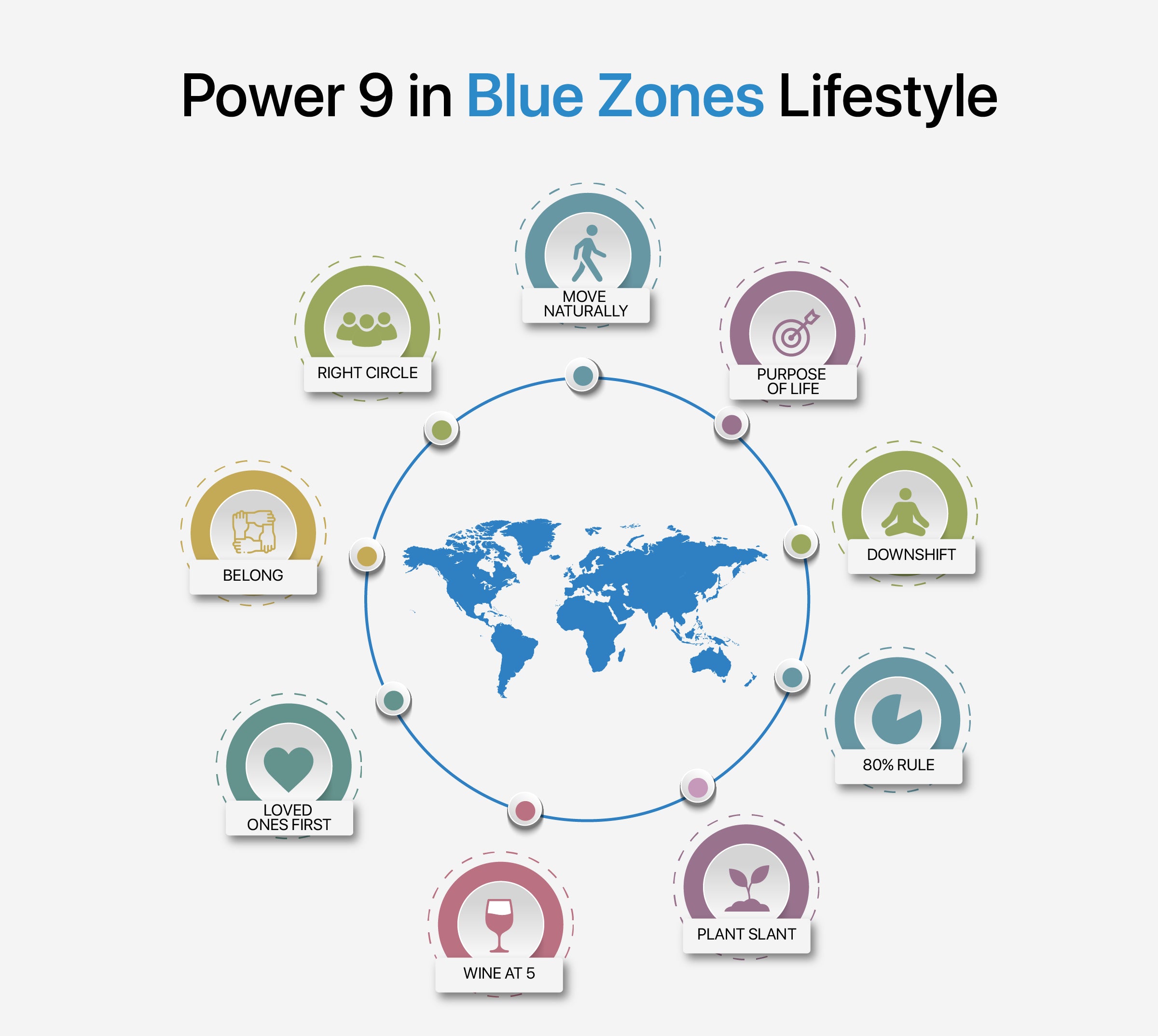
Across all five Blue Zone communities, despite their dramatically different geographies, languages, religions, and cuisines, researchers found nine converging lifestyle principles. These became known as the Power 9.
They found that the lifestyles of all Blue Zones residents shared nine specific characteristics. These are called the Power 9.
Here they are, explained in plain terms:
1. Move Naturally Blue Zone residents do not go to the gym. They move constantly because their environments and occupations require it. Walking, gardening, hand-washing clothes, and climbing stairs are built into their daily routines rather than added on top.
2. Purpose Knowing why you wake up in the morning is worth up to seven years of additional life expectancy, according to Buettner’s team. Whether you call it ikigai, plan de vida, or simply your reason, having one matters biologically.
3. Downshift Every Blue Zone community has built-in stress-reduction rituals, afternoon naps in Ikaria, prayer among Adventists, happy hour in Sardinia. Chronic stress drives inflammation. Regular downshifting interrupts that cycle.
4. The 80% Rule Eating until you are comfortably not hungry, rather than completely full, reduces caloric intake without calorie counting. The stomach sends fullness signals to the brain with a roughly 20-minute delay. Eating slowly allows those signals to arrive in time.
5. Plant Slant Beans, lentils, tofu, and legumes form the cornerstone of every Blue Zone diet. Meat is present in most communities but consumed in small amounts, typically as a flavor addition rather than a dietary centerpiece.
6. Wine at 5 Most Blue Zone communities (with the notable exception of Loma Linda) drink one to two glasses of wine daily, usually with food and in social contexts. The antioxidant content of red wine, particularly the Sardinian Cannonau variety, appears to provide cardiovascular benefit. This is one of the most contested recommendations, and many health authorities now caution that no amount of alcohol is truly risk-free.
7. Belong All but five of the 263 centenarians Buettner’s team interviewed belonged to a faith-based community. Attending services four times a month has been associated with 14 additional years of life expectancy. The mechanism is unclear, but community, stress reduction, and purpose all likely contribute.
8. Loved Ones First Blue Zone centenarians consistently prioritized family above work or leisure. They kept aging parents and grandparents nearby, committed to long-term partners, and invested in their children.
9. Right Tribe Research from the Framingham Studies shows that smoking, obesity, happiness, and even loneliness are contagious. So the social networks of long-lived people have favorably shaped their health behaviors. Your social circle is not just a source of support. It is, in a very real sense, a health intervention.
What Blue Zone Communities Never Eat: The Other Side of the Diet
Understanding what these communities consistently avoid is at least as instructive as understanding what they eat.
None of the five Blue Zone communities built their dietary foundation on ultra-processed foods. None of them ate large amounts of added sugar. None of them consumed significant quantities of refined white flour as a daily staple. None of them drank sugary beverages as their primary hydration source.
This is not because they had exceptional discipline. It is because those products barely existed in their food environments, or arrived late and brought declining health with them.
Limiting or eliminating foods high in sugar, heavily processed items, and those rich in saturated fat is crucial. Such foods are highly palatable, encouraging overeating, and can contribute to weight gain and inflammation, promoting chronic diseases like diabetes, heart disease, and cancer.
The specific foods consistently absent from Blue Zone diets include:
- Refined sugar and sugar-sweetened beverages consumed daily
- Ultra-processed snack foods, packaged goods, and fast food
- Large portions of red meat, particularly processed meats like bacon and sausage
- Refined white bread and pastries as everyday staples
- Highly processed vegetable oils used in industrial frying
- Artificial additives, preservatives, and flavor enhancers
Note that none of these communities were eating perfectly by any nutritional standard. Sardinians eat cured pork. Ikarians drink wine. Nicoyans use lard in some traditional recipes. The point is not perfection. The point is that 95 percent of their food came from whole, recognizable, minimally processed sources, and the other 5 percent was not enough to override the foundational pattern.
The Role of Stress, Sleep, and Community in Blue Zone Longevity
It would be a mistake to reduce Blue Zone longevity to diet alone, even though diet is where most media coverage focuses.
Social connection, purpose, stress management, and sleep are not soft lifestyle factors or nice-to-haves. They are biological variables with measurable effects on inflammation, immune function, hormonal regulation, and cellular aging.
Communities foster a sense of belonging and support, which can lead to reduced stress and improved emotional well-being. Surrounding yourself with like-minded individuals who share your values and aspirations not only enhances your social life, but also contributes significantly to a longer life.
Chronic stress elevates cortisol, a hormone that, in sustained excess, damages cardiovascular tissue, impairs immune function, disrupts sleep, and promotes the kind of visceral fat accumulation most associated with metabolic disease. Every Blue Zone community has cultural mechanisms to interrupt this process regularly. The specific mechanism, whether prayer, napping, socializing, or structured rest, matters less than its consistency.
Sleep is similarly underrepresented in longevity discussions. Blue Zone residents generally sleep when dark and rise with light, maintaining natural circadian rhythms that most modern people disrupt chronically through artificial lighting and late-night screens. The Adventists of Loma Linda observe a weekly day of complete rest. Ikarians nap without apology.
The neuroscience of sleep makes the mechanism clear. Deep sleep is when the brain’s glymphatic system, a kind of cerebrospinal fluid-based cleaning system, flushes out waste proteins associated with neurodegeneration. Regular sleep deprivation allows those proteins to accumulate. Over decades, the difference is measurable.
The Honest Criticism: Where Blue Zone Research Has Limitations
Good journalism and good science both require acknowledging what is not known, and the Blue Zone concept has accumulated legitimate scholarly criticism that deserves direct address rather than dismissal.
The most serious challenge came from a 2019 analysis by researcher Saul Newman, who pointed out that many supercentenarian (people over 110) records are concentrated in regions with historically poor birth record documentation. His argument was that some of the extraordinary age claims might reflect administrative errors rather than genuine biological longevity.
The Blue Zone research team has responded to this criticism directly, arguing that their methodology specifically accounts for record reliability by using multiple independent sources and population-level statistical analysis rather than relying on individual age claims.
A 2026 cross-validation study, which checked civil birth and death records, church archives, and genealogical records across Sardinia, Okinawa, Ikaria, and Nicoya, concluded that while modernization can cause longevity patterns to shift or disappear, these regions serve as natural laboratories for understanding how lifestyle, diet, and social connectivity may contribute to healthy aging.
The honest position is this: the specific longevity claims for individual centenarians may be imprecise. But the broader finding, that populations following these dietary and lifestyle patterns live longer with fewer chronic diseases, is supported by independent research streams including the Adventist Health Studies, the Mediterranean diet literature, and the science of social connection and stress.
Even if the Blue Zones are somewhat imprecise as a concept, the health principles they represent are not.
Practical Blue Zone Habits You Can Adopt Without Moving to Sardinia
Here is the most important thing to understand about Blue Zone longevity: it was never about any single food, supplement, or practice. It was about the cumulative, consistent, daily accumulation of small habits that individually seem minor but collectively reshape metabolic trajectory over decades.
You do not need to move to a Greek island, adopt a religion, or become a shepherd. You need to make a handful of meaningful changes to your existing environment and habits, and maintain them long enough for them to compound.
Research shows that individuals spend about 90 percent of their lives within five miles of their home. To engineer an environment where longevity ensues, Blue Zones worked with researchers to create a blueprint to optimize what they called the Life Radius. The team found that putting the responsibility of curating a healthy environment on an individual does not work, but through policy and environmental changes, Blue Zone Project Communities were able to increase life expectancy, reduce obesity, and make the healthy choice the easy choice for millions of Americans.
The lesson there is architectural: change your environment before you try to change your behavior.
Here are the most impactful and practical applications:
- Replace one processed snack daily with a handful of mixed nuts. Multiple studies, including those from the National Institutes of Health research on nut consumption and mortality, have found that daily nut consumption is associated with significantly reduced all-cause mortality.
- Cook one pot of beans per week and use them across multiple meals. Black beans, lentils, chickpeas, and white beans are the cheapest, most nutrient-dense food in any supermarket.
- Identify your purpose. Write one sentence describing what you exist to contribute to the world beyond your own comfort. Read it weekly.
- Create a downshift ritual. It does not need to be a nap. A 10-minute walk, a consistent bedtime reading habit, or five minutes of quiet before dinner all interrupt the stress cycle meaningfully.
- Eat your largest meal at breakfast or lunch and your smallest at dinner.
- Walk after meals. A 10-minute post-meal walk significantly reduces blood sugar spikes, one of the primary drivers of metabolic disease.
- Invest in your social circle the way you invest in your finances. Identify the three people who most support your wellbeing, and schedule time with them regularly.
Step-by-Step Guide: How to Build a Blue Zone Lifestyle Without Overhauling Your Life
Think of this as a 12-week progressive implementation, not a cold-turkey transformation. Blue Zone habits were formed across lifetimes. You are not going to install them in a weekend.
Week 1 to 2: Audit and Identify
Before adding anything, get honest about what is already there. For one week, write down everything you eat, when you sleep, who you spend time with, and what you feel when you wake up in the morning. No judgment, just data.
Ask yourself: What is already Blue Zone-adjacent in my life? Build on those things first.
Week 3 to 4: The Bean Transition
Cook a large batch of beans or lentils at the start of each week. Add them to at least one meal per day. This single change, if maintained, is one of the most evidence-backed dietary shifts available to anyone.
Swap one processed snack per day for a small handful of mixed, unsalted nuts.
Week 5 to 6: Movement as Environment
Identify two places in your daily life where you can add five to ten minutes of walking without carving special time for it. After breakfast. To a farther parking spot. During a work call. The goal is natural movement woven into routine, not an exercise block added to a packed schedule.
Week 7 to 8: The Downshift Practice
Choose one stress-reduction practice and do it every day for two weeks. Options include a 20-minute afternoon rest, five minutes of quiet sitting after waking, a consistent end-of-workday ritual that signals transition, or a weekly technology-free evening.
Notice what happens to your sleep quality and morning energy.
Week 9 to 10: The Social Investment
Schedule a recurring, standing commitment with at least two people whose company genuinely energizes you. This is not a social obligation. This is a health intervention.
If your current social circle consistently makes you feel drained, stressed, or unhealthy, this is the time to begin, slowly and without drama, shifting toward people who reflect the life you want.
Week 11 to 12: Purpose and Environment
Write your ikigai. It does not need to be grand. It might be: “I exist to raise children who know they are loved,” or “I exist to help people understand difficult things simply,” or “I exist to build beautiful objects with my hands.”
Then look at your physical environment. Where does it make the unhealthy choice easier than the healthy one? What is in your refrigerator right now? What is sitting on your kitchen counter? Small environmental changes, a fruit bowl on the counter, dried beans in a visible jar, athletic shoes by the door, have outsized effects on daily behavior.
Blue Zone Diet Comparison Table: Traditional vs. Modern Eating
| Dietary Factor | Blue Zone Pattern | Modern Western Pattern | Health Impact Difference |
|---|---|---|---|
| Legumes (beans, lentils) | 1 cup daily | Less than 1 serving per week | Blue Zone: 32% reduction in heart disease risk |
| Meat consumption | 2-4 oz, 2-5x per week | 6-8 oz, 1-2 times per day | Blue Zone: significantly lower saturated fat and inflammatory markers |
| Added sugar | Minimal; mostly from fruit | 17 teaspoons per day (US average) | Blue Zone: dramatically lower insulin resistance and inflammation |
| Refined grains | Rare; sourdough and whole grain | Daily; white bread, pasta, pastries | Blue Zone: lower glycemic load and better blood sugar regulation |
| Vegetables | 5-8 servings daily | Under 2 servings daily (US average) | Blue Zone: higher antioxidant intake, lower oxidative stress |
| Nuts | Daily handful (especially Loma Linda) | Rarely or never | Blue Zone: 20% lower all-cause mortality in Adventist studies |
| Processed foods | Less than 5% of diet | 50-60% of daily calories (US) | Blue Zone: dramatically lower inflammation and metabolic disease |
| Olive oil (Ikaria/Sardinia) | Primary cooking fat | Rarely used | Blue Zone: improved cardiovascular markers, reduced LDL oxidation |
| Meal timing | Largest meal at midday; light dinner | Largest meal at dinner | Blue Zone: better circadian metabolic alignment |
| Eating pace | Slow; social; mindful | Fast; often alone or distracted | Blue Zone: lower caloric intake due to fullness signal timing |
| Social meals | Most meals eaten with others | Increasing proportion eaten alone | Blue Zone: lower cortisol, higher satisfaction, social accountability |
| Fermented foods (yogurt, miso, wine) | Regular, in traditional forms | Rare; often replaced by supplements | Blue Zone: better gut microbiome diversity and immune function |
The Deeper Lesson: Longevity Is an Environment, Not a Supplement
Perhaps the most radical and underreported finding from twenty years of Blue Zone research is this: individual willpower is almost irrelevant.
The people living longest in these communities are not doing it through discipline. They are doing it because their entire environment, the food available, the distances they walk, the social obligations they have, the purposes they serve, makes longevity the path of least resistance.
In our fast-paced, hustle-driven culture, it is easy to get caught up in the quest for quick fixes and shortcuts to a longer, healthier life. But what Buettner’s research shows is that there are no quick fixes or magical pills that can replace the benefits of a well-rounded lifestyle. True longevity comes from an internal drive to live healthily and happily, incorporating small, sustainable changes rather than seeking immediate solutions.
This is the insight that most wellness content glosses over because it is not commercially interesting. Supplements are commercially interesting. Specific branded diets are commercially interesting. “Restructure your environment and social circle to make healthy choices automatic” is harder to sell in a 30-second ad.
But it is what the data consistently shows.
Harvard’s T.H. Chan School of Public Health research on longevity and the dietary patterns associated with it reinforces this finding repeatedly: the communities and dietary patterns most strongly associated with long, healthy lives share certain consistent features, and none of those features involve superfoods, biohacking, or intermittent cold plunges.
They involve beans. They involve walking. They involve people you love sitting around a table.
Conclusion: What a 97-Year-Old Gardener Can Teach a 35-Year-Old Professional
Go back to the woman we met at the beginning. The one tending her garden on a Greek island, napping after lunch, meeting friends for tea.
She has never heard of a macro. She does not own a fitness tracker. She probably could not tell you what resveratrol is, even though she has been consuming it in her daily glass of Sardinian-style wine for 70 years.
She is living long not because she is doing something extraordinary. She is living long because she has spent her entire life doing ordinary things extraordinarily consistently. Eating mostly plants. Moving constantly. Sleeping well. Belonging to people who need her. Waking up every morning knowing why.
The Blue Zone research does not promise immortality. It does not claim to explain every centenarian or refute every critic. What it does, reliably and reproducibly, is show us what a human life sustained in health can look like when the environment, community, diet, and purpose are working together rather than against each other.
You do not have to move to Ikaria to do this. But you might have to make a pot of beans this Sunday. You might have to call a friend you have been meaning to call for three months. You might have to put down your phone 30 minutes before bed.
None of that is a secret. All of it is a choice. The question is whether you will start choosing it consistently enough and early enough to feel the difference.
The research suggests you will.
Sources and references for this article include peer-reviewed research published in PMC (National Library of Medicine), the Adventist Health Studies, the Blue Zones research team’s demographic methodology documentation, Harvard Health Publishing, and the Current Research in Nutrition and Food Science Journal (2025). All statistics cited reflect findings current at the time of writing.